Regenerative Urbanism - Principle 3: Call forth a collective vocation
InsightsDelivering this principle requires fostering collaborative efforts that support personal goals while promoting human belonging, inclusivity, democracy, and cultural diversity. When a community awakens its uniqueness and operates authentically from its core identity, life can thrive. Regenerative sustainability becomes possible when reciprocal developmental relationships occur that promote the wellbeing of the whole system they occupy (Many, Haggard and Regenesis, 2019).
Defining Collective Vocation
Many urban projects lack any meaningful purpose beyond serving the perceived needs of a community. Moreover, they tend to be imposed upon communities rather than truly developed by or with them. These projects rarely belong to the places they occupy, and over time, this incongruity becomes increasingly obvious as they fail over time. Projects that become truly embedded in a place and its communities are based on principles of participatory urbanism - a process where the community becomes the extended design team and actively participates in reshaping local systems across economic, social, and environmental dimensions. Collective action around a shared purpose has always yielded powerful benefits within human organisations, provided it is supported by strong values and a culture of collaboration. However, while collective voices can develop around specific community issues, more powerful synergies emerge when collective actions shift a place's purpose to contribute meaningfully to its wider context, thereby building on its patterns of nested relationships. When members of communities find their purpose through this process, such a calling takes on the form of a collective vocation.
The Role of Belonging and Individual Needs
For collective vocation to succeed, individuals must connect to a sense of belonging within the group. Owen Eastwood (2021), in his work on belonging in groups and organizations, identifies the need for clear and unifying mission and vision that balances individual needs with the tribe's wellbeing, thus defining the tribe's identity. Eastwood references the Māori concept of Whakapapa, which connects people to their ancestors, land, and each other. The fundamental premise is that everyone belongs - there is a basic human need to belong. Groups require shared symbols, rituals, and stories that give them a sense of identity. Within collective vocation, we must recognize individual goals and needs, building on personal pathways to self-actualization or, as Mihaly Csikszentmihalyi (1990) described, their sense of flow, while contributing to the group's collective purpose. Eastwood discusses how compelling narratives unite communities through story-based leadership, which parallels how urban projects need strong narratives to engage stakeholders.
Creating Value-Added Roles
Regenesis (2016) refers to the concept of nested vocations, where communities engage in collaborative efforts toward a collective vocation, and individual vocations align with larger purposes, creating nested systems of contribution. These can be understood as value-adding roles that any community member can play, contributing to the wellbeing of the wider systems within a place. In my own village of Bramhall, a small group of volunteers - 'Bramhall in Bloom' - regularly plants flower beds in a grass verge that falls within the ambiguous space between public and private ownership. Viewed by thousands of passers by daily, their contribution and civic pride are tangible, growing and spreading to other locations throughout the village. When value-adding roles are created, reciprocity results, securing viability within the wider living system. Where community collectives unite behind projects, the projects themselves create value-adding roles in the wider area, taking on the living personality of the group.
Case Studies
The following case studies provide both international and UK examples of these principles in action, some of which exemplify Planit’s very own approach to creative engagement, which can form a pathway towards a collective vocation.
Curibita, Brazil: A City as school of Ecological Urbanism
Curitiba serves as an exemplary model of collective vocation in action. The city has achieved significant green space per capita, volunteer planting of 1.5 million trees, an efficient bus system with declining traffic, the world's best recycling results, and economic growth higher than the national average. Many programs are designed to pay for themselves, address multiple civic issues simultaneously, and enable other programs' work - all achieved on a limited civic budget. This success was based on a vision of the city functioning as a school of ecological urbanism, leveraging the will of the people with coresponsibility. For example, in the favelas where waste recovery vehicles couldn't reach, residents could exchange recycling for community currency in the form of tokens. As this vocation became embedded in the city's culture, innovation emerged within civic and community partnerships.
Forms of Capital in Community Development
While vocation is explored in greater detail within principle 4 (enabling co-evolution of stakeholder systems), it's important to recognize that a group's endeavour can take the form of collective vocation that serves a place. This service manifests as energy or capital, which can take various forms. Toby Hemenway (2015) recognizes that useful activities generate surplus. Once achieved, you need to find catchments for this surplus; otherwise, it will drain away like water rushing over compacted soil. Once caught and stored, surpluses become like capital stock, which extends far beyond financial resources.
Permaculturalist Ethan Roland identifies eight forms of capital:
- Social Capital: Goodwill within your community rendered by your service to it
- Material Capital: Raw, unprocessed nonliving resources such as rock, buildings, tools, and fuel
- Living Capital (Natural Capital): Plants, animals, soil, and ecosystems, including your own health
- Intellectual Capital: What we have learned
- Experiential Capital: What we have experienced in the form of wisdom
- Spiritual Capital: Achieving deep connection
- Cultural Capital: Shared arts, music, stories, and ideas - the glue of a community
- Financial Capital: Money and financial assets
Unlike money, other forms of capital can accumulate when tended well. Given that money represents a claim on other assets, in a volatile economy it makes sense to convert it into forms of capital to preserve its value. For example, investing money in building good soil will produce food even when food prices increase; a mastered skill won't be lost despite a stock market crash; a solar panel creates energy regardless of fluctuating prices. Understanding how different forms of capital work helps in designing appropriate methods to capture and utilise them effectively.
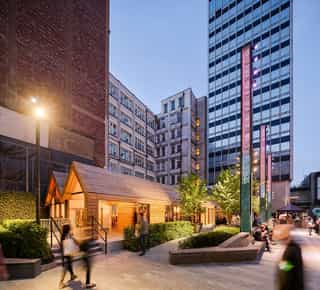
The Pilcrow Pub - Community Building Workshops - activating space
Home Baked, Anfield: Community-Led Regeneration
A compelling example of this principle in action is Home Baked CIC, engaged as part of Planit's work on the Anfield/Breckfield Masterplan. In 2012, local residents formed Homebaked Community Land Trust (CLT) to rescue their old Mitchell's Bakery from demolition and transfer it to community ownership. Beginning as part of the 2Up2Down Liverpool Biennial project (artists + residents + architects), they coimagined the bakery and surrounding housing, creating a community-driven mission: to regenerate "brick by brick and loaf by loaf" via community-owned spaces and affordable homes. This community bakery became an anchor within wider regeneration efforts, opening as a worker cooperative employing locals, training residents, and selling pies to 40,000 match-day fans. The CLT raised funding from Power to Change, Liverpool City Council, and other sources to refurbish adjacent vacant terraces into 26 quality affordable homes and retail units, involving local trainees and residents in design and construction. Homebaked's success has inspired the Council and other funders to explore deeper asset transfers and community-led redevelopment in Anfield, shifting dialogue away from top-down, stadium-focused regeneration. Profits from the bakery are funneled back into renovation, employment, training, and local supply chains, spurring new social enterprises and spillover foot traffic that supports local cafes and creatives. Homebaked exemplifies the regenerative principle of calling forth collective vocation - transforming despair into shared ambition, forging shared identity rooted in local ownership, and creating a replicable model of citizen-led, design-informed, economically and socially resilient urban renewal.
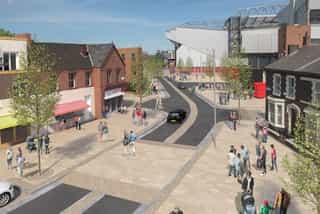
Planit's Plans for Walton Breck Road gave prominence to Home Baked within the high street
Facilitating Collective Voice
Leadership within the built environment involves encouraging others to find their own voice and helping them towards a collective endeavour and untimely a collective vocation. In many group situations, the loudest voice can dominate. These discussions require facilitation to ensure unheard voices are heard and contribute to collective discussion. Moreover, the role of the facilitator is to explore conflicting opinions and navigate to a way forward that considers an alternative scenario which captures the positives of alternative viewpoints. There are several creative concepts and techniques that encourage participation: creating safe space, connecting people to the essence of a place and their collective vocation - these are discussed within the attached case studies.
Eastwood (2021) refers to managing "alphas" -individuals with strong leadership qualities and competitive drives - focusing on harnessing their energy for collective goals while ensuring cohesive team environments. This involves building trust and providing clear direction. By understanding and leveraging the unique strengths of alpha personalities, leaders can create high-performing teams where individual ambitions align with overall team vision.
Psychological safety is a core theme of his book, including creating environments where people feel safe to express themselves and contribute authentically. It's important to hold space for listening, ideation, debate, clarification, refinement, decisionmaking, and action. Disagreement can be valuable when it serves to hone and polish larger concepts and direction while allowing for a diverse collection of projects that realise the vision.
NOMA: Comunity Development and Collaborative Design
Community involvement has also been at the heart of the NOMA vision from the outset playing a pivotal role in the planning and decision-making process throughout. In 2018, NOMA took part in a collaborative community engagement project through a partnership with Manchester Metropolitan University (MMU).
Oubliette was a first for MMU’s EdLab unit in seeking to engage a number of cross-faculty student disciplines - from art to 3D design, to interior design, to marketing, to engineering, to business to law - in the production of a maths-themed escape room, designed for secondary school children as an extra-curricular initiative to break traditional, classroom-based methods of learning.
Oubliette exceeded its targets and enabled 1,500 school children from 50 schools across the North West to experience a truly unique, interactive, and educational experience at NOMA. The success of the project has also led Oubliette winning The Guardian’s Teaching Excellence Award in 2019.
The NOMA Community Fund has also welcomed applications from grassroots community groups working with children and young people aged 11–25 within five-mile radius of NOMA. This included sports clubs, mental health charities, youth clubs, and community centres, amongst others.
Taken together, these activities demonstrate the importance placed upon community involvement in shaping the regeneration of the area.
The Pilcrow Pub, 2014: In 2014, what was then 'Standard Practice' - a small group of urban activators - pioneered a participative co-design approach in the delivery of The Pilcrow Pub - the pub that Manchester built. It involved 600 members of the community as creator-participants in the design and build of a local pub. This project lit the fuse for a new, more equitable way of developing places. In recent years we have taken this approach and applied it to urban landscapes. Involving the public as decision makers and collaborators in the delivery of PLANT.
This approach allowed us to kickstart a sense of community in what was otherwise a place that very few people felt a sense of belonging to. In addition, it served to activate a new square and create social value impact in terms of new skills and jobs created.
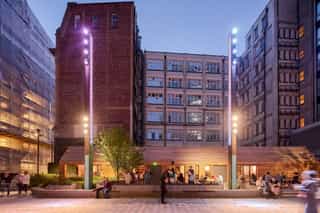
The Pilcrow Pub
Halifax Streets for People: Encouraging Particiaption and Co-Creation
The Halifax Streets for People project is an ambitious project to improve walking and cycling across the town, particularly between North and West Halifax. The project is part of the Leeds City Region Transforming Cities Fund (TCF), a major new programme of investment that aims to create a step change in travel across the West Yorkshire region. As part of the infrastructure improvements, and working in collaboration with the community, Planit identified a number of opportunities were identified for public artworks to enhance sense of place, improve perceptions and humanise the built environment.
An Arts and Culture workstream was developed alongside the wider project to explore opportunities for co-creation of these artworks. The aim was to maximise the impact of the artworks by engaging with the local community to create meaningful art installations with a deep connection to people and place. The Arts and Culture workstream demonstrates an innovative approach to delivering Social Value for the wider project, exploring an alternative method for supporting community wellbeing and empowerment in Halifax.
For this approach to delivering public art, finding the right artists is key. The process is just as important as the end result so artists must be process-driven and have experience of working with communities, as well as able to deliver on the artwork.
The overall approach was defined and agreed from the outset; a series of workshops were held with the local community, led by local artists. The process was informed by the textile industry and the rich heritage of Halifax. The first step used creative writing to explore people's connection to the town in an easily accessible manner, the second used techniques from textiles to translate the words into shapes. These words and shapes were then distorted into the architecture of the space, resulting in a collectively designed artwork which will lift the area and embed a distinctive identity which has been truly shaped by the place and the people who inhabit it.
Conclusion
Principle 3, call forth a collective vocation, is defined by the emergence of stakeholder groups and the process of self-organization around common purpose that seeks to create positive impact through projects or collective action. This becomes the project's or group's collective vocation, where the sum of the whole exceeds its parts. Ideally, this should emerge from the community itself, but external interventions - through local or regional government - should focus on creating conditions for collective action to occur. The concepts outlined here facilitate both divergence and convergence of opinion and activities, components essential for stakeholder groups to function, develop resilience and survive to co-evolve in the future.
The successful implementation of collective vocation requires careful attention to belonging, individual needs, value creation and capture and collaborative design processes. When these elements align, communities can achieve remarkable transformation that serves both local needs and broader regenerative goals.
Related Thoughts
Power of Networks
Power of Networks
Climate Emergency and Public Realm Carbon Assessment Roundtable
Climate Emergency and Public Realm Carbon Assessment Roundtable
Planit’s Urban Design team create a new vision for Hull