Urban Agroecology: Reimagining Cities Through Food, Ecology and Place
InsightsBy 2050, it is projects that 90% of the UK’s population will reside in urban centres, a shift that will place significant pressure on food security, ecological health and social equity.
With this increase in urban population, technological developments and a shift in lifestyle, people are spending 90% of their time indoors - even those in rural areas are not immune to it (Rewilding Britain). Society is becoming increasingly detached from the environment and with this comes ‘a wealth of research that illustrates how disconnection from nature is linked to mental and physical illness’ (Rewilding Britain).
In parallel to this ‘the Global Food Security Index (GFSI) shows that the global food environment is deteriorating’ (Economist Impact, 2022) and ’there has been a notable decrease in food secure households’ (DEFRA, 2024). With rapid urbanisation comes a concentration of food demand putting further strain on global food security, which raises an important question: ‘How do we feed a city?’ (Steel, 2009).
Rapid urbanisation and climate change are converging to place unprecedented pressure on ecosystems and the natural processes that support life, creating interconnected challenges that demand more holistic approaches to urban development.
- Lower Crop Yields: Higher temperatures and heat stress directly decrease the productivity of major staple crops like wheat, maize and rice.
- Precipitation Extremes: Severe droughts deplete vital irrigation and dry out soil, whilst conversely heavy rainfall and flash flooding wash away crops or bury them in sediment.
- Livestock Stress: Heat stress reduces the production of meat, milk and eggs.
- Fishery Stress: Rising ocean temperatures and acidification are changing marine ecosystems, shrinking vital fish populations.
- Escalating Household Food Bills: Reduced agricultural output at home and abroad have triggered rapid food price inflation.
- Import Vulnerability for Fresh Produce: We rely heavily on imports for roughly 40% of our food.
- Agricultural Pests and Diseases: Warmer, wetter UK winters prevent the natural winter die-off of crop pests and pathogens.
- Soil Degradation and Erosion: Flash flooding and prolongues saturation wash away fertile topsoil and deplete vital nutrients.
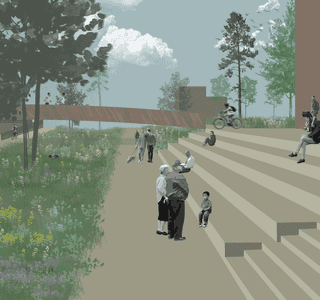
What is Urban Agroecology?
Urban agroecology applies ecological principles to urban food production, focusing on how agricultural practices interact with ecological systems within our urban centres. It can be used to study and develop approaches to urban food production that consider environmental, social, and resource-related factors.
There are 10 principles to agroecology as outlined by the Food and Agriculture Organisation of the United Nations (FAO, 2019) which was outlined to create a framework that can be adapted to work at a variety of scales. The principles cover every facet of our food systems rather than focusing in on particular aspects which is where agroecology differs from some of the other movements. It can change its scope to address systems at all scales.
Agroecology Principles
- Diversity: Promote biological and genetic diversity in crops, animals and farming systems to improve resilience and productivity.
- Co-creation and sharing knowledge by involving farmers, researchers and communities in the learning process.
- Synergies: Enhance interactions between different parts of the farming system to boost efficiency and resilience.
- Recycling: Reuse nutrients and organic matter (like compost and animal manure) within the farm to reduce waste and dependence on external inputs.
- Resilience: Strengthen the ability of farming systems to withstand shocks such as climate change, pests and market volatility.
- Human and Social Values: Support equity, fairness, and well-being for all people involved in food systems.
- Culture and Food traditions: Respect and preserve local food cultures, knowledge, and traditions that are closely tied to farming the land.
- Responsible Governance: Promote policies and institutions that empower communities and encourage inclusive decision-making in agriculture.
- Circular and Solidarity Economy: Build local food systems that supoort fair trade, cooperation, and economic inclusion, especially for small-scale producers.
How does it differ from Conventional Agriculture and Permaculture?
Conventional agriculture favours high crop yields through use of pesticides and fertilisers to maximise the yield (R&S Forigo, 2025), which does help to address the growing food demand globally and can reduce the cost of the food we consume. These fertilisers and pesticides can pollute the water and deplete the nutrition of the soil. Whilst monocultures in fields impact biodiversity, specifically local animal and plant species.
Permaculture promotes a closed loop system much like natural systems where there is no waste, every output feeds into another aspect of the system, it is guided by three principal ethics: ‘the soil, water and air must be viewed as sacrosanct to sustainability, and need to be protected and regenerated… if we flourish as part of a regenerative, rather than a degenerative design, the Earth will become abundant with us… each of us should take no more than what we need…’ (Rhodes, 2015) it encompasses aspects such as water management, food forests and housing, with an emphasis on ecology. It is a holistic approach usually in smaller scale projects and therefore doesn’t have the scalability of agroecology.
Agroecology enriches landscape architecture by embedding ecological principles into the design of productive and resilient landscapes. Enhancing ecosystems through integrating nature-based solutions such as green corridors creating greater habitat connectivity, food forests where people can forage, providing food for both us and nature and productive rain gardens which can help alleviate flooding, whilst improving water quality, which can help not only with creating productive landscapes, but also climate resilient and increase biodiversity within urban centres. It allows us to design multifunctional spaces which can respond to environmental challenges such as the urban heat island, enrich ecology within our cities and empower local communities through food sovereignty.
Food Security
Urban food networks have an important role to play in food security, they can improve food security though several aspects: ‘increased food availability, enhanced food access, improved food utilisation and greater food system stability’ (Sustainability Directory, 2025) Urban farms and productive gardens supplement existing food supplies but don’t replace rural farms but it could reduce food miles when grown and consumed within a city. Produce grown and consumed within a city shortens the ‘farm to table’ timeline, meaning access to fresher produce which is more nutritious when consumed. When you live around the food you eat you can be exposed to a wider variety of produce, encouraging healthier habits around food.
Low income households may struggle to afford healthy, nutritious food and with the rising cost of food this problem is further exacerbated. Outside considerations of budgeting, food planning and using programmes which can provide assistance, they can consider tapping into community resources and growing a portion of their own food in order to increase the household’s food security. Community gardens play a vital role in improving food security. These shared spaces empower the local community to grow their own fruit and vegetables, through shared knowledge of those who use these spaces, providing households with a potentially greater variety of nutritious crops at a lower cost.
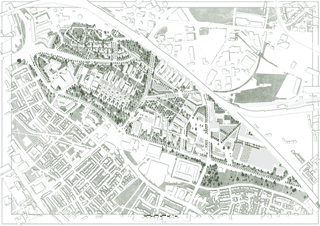
Future Fields: Recultivating Ardwick
My thesis paper sought to explore the role urban agroecological landscapes could have in food security and improving the connection of the urban population to nature, it comprised of a thesis paper analysing the context, case studies and first-hand research into people’s personal horticulture experience, their perceptions of agriculture and their thoughts on urban ecology. The data was collected and analysed to inform the design of a project in Ardwick, Manchester which had these principles embedded within it.
What role will urban agroecological landscapes have in food security and improving the connection of the urban population to nature?
Key findings:
- Over 85% of respondents would grow their own food or increase the food they grew if food supplies were at risk
- 84% of respondents would support the cost increase in produce if it meant more environmentally conscious farming practices
- 30% of respondents do not consider how food it produced when they shop or eat out
- 35% would actively purchase produce grown aquaponically and a further 50% are neutral not impacting their decision either way
- 75% of respondents not knowing who produced the food they eat or where it comes from
- Over 85% believe nature can thrive in towns and cities, with the three largest perceived factors contributing to our increased disconnect from nature in urban areas being 65% Urbanisation, 65%Technology and Screen Time and roughly 60% Lifestyle and work patterns.
How might agroecology impact how we design cities?
Throughout the design process, agroecology emerged not simply as an approach to food production, but as a way of thinking about cities as interconnected living systems where environmental, social, and economic processes are deeply intertwined. Reflecting on these ideas, considering how agroecological thinking might reshape the way we design cities, proposing nine principles that translate the lessons from my thesis project into a broader framework for regenerative and adaptive urban design:
1. Design Multifunctional Green Infrastructure
Create landscapes that combine food production with biodiversity, recreation, and climate adaptation. Rather than ornamental planting alone, incorporate edible trees, perennial crops, herbs, and productive hedgerows into parks, housing developments, schools, and public spaces.
- Edible planting within Sustainable Drainage Systems (SuDS)
- Productive community orchards
- Edible streetscapes in new developments
2. Restore Hedgerows and Agroforestry Systems
Reintroduce traditional British landscape features such as hedgerows alongside agroforestry systems that integrate trees with food production. These improve habitat connectivity, carbon sequestration, and landscape character while producing food.
- Shelterbelts around new developments
- Urban food forests
- Productive woodland edges
- Traditional mixed-species hedgerows
3. Integrate Sustainable Water Management with Food Production
Use water-sensitive urban design to capture, store, and reuse rainfall for irrigation while reducing flood risk. Productive landscapes can form part of wider SuDS networks.
- Rain gardens irrigating community gardens
- Swales planted with edible species where appropriate
- Rainwater harvesting for allotments
- Productive detention basins
4. Enhance Biodiversity through Diverse Planting
Design planting schemes that support pollinators, birds, soil organisms, and beneficial insects while also producing food. Diversity reduces reliance on pesticides and increases ecological resilience.
- Pollinator corridors linking parks and green spaces
- Wildflower meadows adjacent to orchards
- Native fruiting species
- Integrated habitat networks within developments
5. Protect and Regenerate Soils
Healthy soils underpin productive and resilient landscapes. Landscape architects can prioritise soil conservation during construction and specify practices that build soil organic matter over time.
- Reusing site-won topsoil
- Composting green waste locally
- Reduced soil compaction
- Organic soil improvement strategies
6. Design Climate-Resilient Productive Landscapes
Select diverse, climate-adapted planting that can withstand increasing temperatures, changing rainfall patterns, and extreme weather while maintaining food production and ecosystem services.
- Drought-tolerant edible species
- Shade-producing orchards
- Flood-tolerant planting in river corridors
- Windbreak planting in exposed sites
7. Strengthen Community Food Infrastructure
Design neighbourhoods that include spaces for food growing alongside facilities that support local food systems, such as tool storage, composting, markets, and education spaces.
- Community gardens
- Allotments integrated into housing developments
- School food gardens
- Community composting hubs
8. Embed Local Food Systems into Spatial Planning
Consider food production as essential infrastructure within masterplans and local planning policy. This includes protecting productive land and improving connections between producers, markets, and communities.
- Food-growing spaces within Local Plans
- Green Belt and peri-urban agriculture integration
- Local food hubs
- Active travel routes connecting farms, markets, and neighbourhoods
9. Promote Participatory Stewardship and Long-Term Management
Agroecological landscapes depend on ongoing community involvement. Engage residents, local farmers, schools, charities, and land managers throughout design and management.
- Co-design workshops
- Community stewardship agreements
- Partnerships with local authorities and environmental charities
- Volunteer-led habitat and food-growing programmes
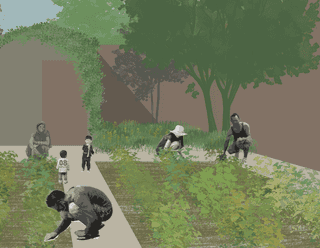
In addition to the above, there are numerous considerations when designing with agroecological considerations. There’s no singular answer. Below are some of the many considerations when designing productive landscapes:
Soil Contamination Testing
Ensuring soil is free of contaminants before considering growing root vegetables etc.
Air Pollution Buffers
Avoid planting leafy greens or fuzzy fruits within 10-15m of busy roads to prevent the absorption of traffic related pollution.
Microclimate
Consider microclimate and aspect when specifying planting, south facing walls trap heat and radiate later in the evenings.
Zoning Fruit Drop
Consider locations of fruiting trees, non persistent fruiting trees will drop fruit on hard surfaces and could present a slip hazard and staining.
Wildlife Planning
Consider species selection, select species that do not attract pests near spill out spaces or playgrounds.
Multi-Seasonal Aesthetics
Fruiting trees for example can prove multiseasonal interest.
Perennial Foundations
Anchor the scheme with low-maintenance edible perennials to reduce the annual replanting workload.
Water Management
Consider proximity to SuDs and consider drought resilient species. Species that once established are resilient.
Urban Agroecology Through a Regenerative Lens
If regenerative design asks us to restore relationships between people and place, then urban agroecology in my opinion, offers one of the most tangible ways to put that ambition into practice.
Urban agroecology is inherently regenerative.
Related Thoughts
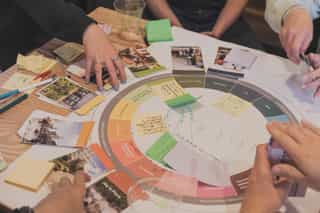
Planit’s Regenerative Design Tool Launches
Planit’s Regenerative Design Tool Launches
Regenerative Urbanism - Principle 5: Designing as Part of a Living Network
Regenerative Urbanism - Principle 5: Designing as Part of a Living Network

Regenerative Urbanism - Principle 4: Call forth a collective vocation