City Strategies - A Framework for Radical Transformation
InsightsAt Planit, we support Local Authorities, Developers, Homes England, and collaborators through our strategic city-wide and neighbourhood thinking to create compelling and investable place-based narratives. Our work across Sheffield, Leeds, and Hull has delivered measurable transformation...
- £35m+ in secured funding (£5m+ Sheffield, £30m Leeds, plus Hull devolution funding)
- 26,000+ new homes planned (20,000 Sheffield, 6,000 Hull)
- 2,500+ jobs projected through the Leeds Innovation Arc
- £200m+ investment catalysed across the three cities
- Through our proven methodology, we create visions that capitalise on each city's unique strengths and assets to deliver transformational change.
Our City Thinking
Through our work in Sheffield, Leeds and Hull we have created a formula for cities to succeed, transforming themselves by creating visions that are simple and compelling - capitalising on the unique strengths and assets of a city to create powerful leverage points to deliver transformational change.
We identify 3 key elements in the process:
Create a clear placed-based narrative and vision for your city that allows the coordination and focus of strategies, policy, activities and investment.
Identify neighbourhoods and catalyst sites that support the delivery of the vision and ensure that the positive impacts can be catalytic.
Galvanise delivery partners around the implementation of the vision and catalyst sites, providing certainty and direction over public sector support to enable its delivery through focussed investment.
Sheffield City Centre Vision and Neighbourhood Frameworks
Context and Approach
Working for Sheffield City Council, the framework has informed the emerging Sheffield Local Plan - forming a unique approach to holistic city making, whilst considering the importance of liveable neighbourhoods as units of change.
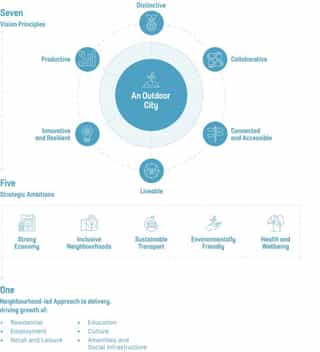
It supports the city on its path to Zero carbon, delivering on Sheffield City Council’s vision of the Outdoor City. It has also enabled and catalysed a liveable city comprising 20,000 hew homes – employing a bespoke and innovative approach to calculating capacity.
The framework for delivery and potential intervention, allows the Council to be proactive in overcoming viability issues, attracting national and international developers and investment.
The vision will be delivered through a series of neighbourhood priority frameworks and catalyst projects. The document was approved by the Council and key neighbourhood elements taken forward in the Local Plan and a series of Development Frameworks, which are now the subject of tenders for the establishment of development partnerships.
Impacts
The plan provides the necessary strategic thinking at the city scale. It builds on a clear vision of the Outdoor City and considers physical, environmental, economic, and social considerations holistically. In turn, it exploits interdependent connections across sectors to deliver cross-cutting impacts and policy synergy. It then delivers this at the neighbourhood level - the most important unit of change within any city.
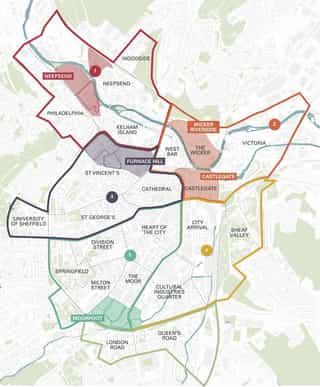
↑ Sheffield City Neighbourhoods and Catalyst Sites
Physical and Environmental Quality
Supported by a strong strategic vision for the ‘Outdoor City’, the plan enables the delivery of:
- A clear sense of place for the city by shaping distinctive and inclusive neighbourhoods in which a diverse demographic of people can live, work and play.
- Enhanced connectivity and accessibility for the City Centre through integrated and sustainable transport for everyone in the community.
- High quality spaces and places that facilitate health and wellbeing for all.
- New green infrastructure where gaps in provision are identified to increase biodiversity in the City Centre and build on the success of the Grey to Green initiative.
The plan will achieve the above by landing the strategic principles at the neighbourhood level. For example:
- Delivering 3.4 Ha of new open space across the City, including a new Park at Neepsend and Furnace Hill
- Creating new squares at Castlegate, Wicker Riverside, and Moorfoot
- Extending the Grey to Green initiative
- Breaking down the barrier of the ring road through high-quality public realm proposals, which link across the A61 and Netherthorpe Road, with pedestrian and cyclist priority crossing points
- Promoting healthy streets within each neighbourhood.
The strategy creates area-specific principles to regenerate existing heritage and buildings of quality, complementing them with new mixed-use buildings (including varying typologies) to create healthy, liveable densities.
Environment
The Council has declared a Climate Emergency and set a target for the city to be zero carbon by 2030. This declaration was supported by the development of Sheffield’s Clean Air Plan with the aim to bring emissions within legal limits. Planit and Deloitte recognised that the City Strategy could play a key role in unlocking new solutions to the Climate Change emergency by requiring all new developments to consider how to contribute to achieving net zero targets. As well as facilitating actions to change the habits of all users of the city – residents, workers and visitors - to live lower carbon lifestyles.
The Strategic Vision recognises that the City Centre plays a key role in unlocking new solutions to the Climate Change emergency. Strategically located, it highlighted that the City Centre should act as a hub for the city region’s public transport network whilst simultaneously supporting new modes of active travel and sustainable housing growth.
A strong stance has been taken with ambitious, clear and implementable actions identified in order to support the development of a sustainable and resilient city that achieves on its net zero strategy.
The work facilitates the adoption of new technologies to accelerate carbon reduction strategies and investment in infrastructure which facilitates the adoption of low carbon lifestyles.
The team recognised the role that urban planning can place in facilitating the race to net zero emissions. Densifying existing built-up areas will reduce the carbon footprint of both new and existing residents especially in large cities like Sheffield, which are currently way below London’s density levels.
The Strategy sets out the way that the Council will seek to create resilience to the effects of climate change:
- More areas of urban greenspace throughout the City Centre, not only for the enjoyment of residents and workers but also to increase biodiversity; provide sustainable drainage, and combat the urban heat island effect
- Green roofs and more porous surfaces will be encouraged to hold rainfall for longer and feed into streams and rivers rather than combined sewers
- The Grey to Green route approach will be expanded through the City Centre as opportunities become available
- Reinvigorate and grow the City Centre district heating network in order to help Sheffield become a lower energy, lower carbon city
- Waterways to be accessible, de-culverted and rich in habitat to make an important contribution to the economic and environmental quality of the city
- Encourage sustainable transport through targeted and sustainable public transport interventions and infrastructure improvements
- Zero Carbon Mitigation Pathway - this will be achieved through new planning policies and guidance for new development and through Government funding/incentives to enable retrofitting the existing building stock
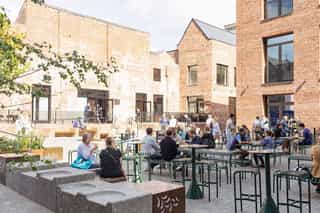
↑ The Cambridge Street Collective, Heart of the City, Sheffield
Social Wellbeing
Sheffield can be defined by its people, who are simultaneously down-to-earth and restless, and never fail to raise an eyebrow. A city of makers, past and future, their spirit fuels the collaborative, inventive culture that’s unique to Sheffield.
With a population set to increase from 584,853 people (2019) to 648,410 people by 2043, this Strategic Vision places Sheffielders at the heart of future development of a growing city. Repopulating the City Centre through the creation of new distinctive neighbourhoods is a fundamental thread to the City Centre's future. The Sheffield City Centre Strategic Vision recognises that these neighbourhoods will put people first, have sustainability at the core, and be inclusive. They will provide high-quality new homes that will cater for all segments of the community and lead to the creation of a more balanced, diversified residential population, generating a vibrant, sustainable community in the City Centre.
Through the strategy, the City Centre has the capacity to deliver at least 20,000 new homes. Delivering more homes will provide much needed housing and importantly act as the ‘glue’ to bring together and strengthen the key components that make up the City Centre - culture, arts, work, leisure, for example. More homes in the City Centre will also reduce the impact of urban sprawl on the surrounding countryside. Whilst also positively contributing to the low carbon agenda by reducing the demand on Sheffield’s wider road and public transport network.
Establishing inclusive neighbourhoods and providing new homes for all people in the community is a fundamental thread to the future City Centre. Albeit only one element of the centre’s ecosystem. Sheffield should be seen as the place to live, work and play with the City Centre accommodating a wide range of activities and amenities that encourage footfall and provide a reason for people to visit the City Centre.
The plan creates the mechanism to deliver the right kind of development in the City Centre and fostering healthy, vibrant, inclusive, and environmentally sustainable communities.
It requires the integration of social infrastructure and the provision 3 new neighbourhood hubs, including a new school, to form hearts within key neighbourhoods. These hubs will form key nodes that harness synergy and interconnects the city’s key urban systems; enabling local businesses and communities to transform the economic, social and ecological health of their city.
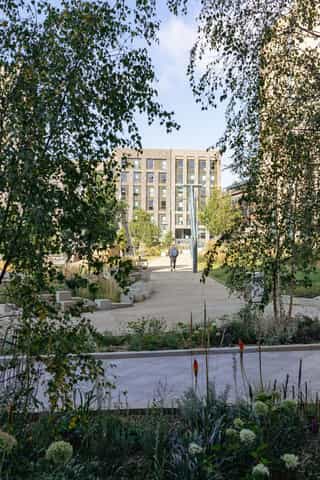
↑ Pound's Park, Sheffield - City-scale, child-friendly park
Economic
The strategy recognises the role the City Centre can play to advance the knowledge-based economy, namely: fostering entrepreneurship and SME growth, attracting knowledge-intensive tenants, and addressing the skills mismatch. It does this by forming principles to bring together research and business.
Sheffield has had great success in linking research with business, such as the AMRC. The work highlights how these types of connections would permeate through the City Centre, capitalising on opportunities for collaboration and start-ups – The Cultural Industries Quarter is a good example of this already happening.
The framework identifies further opportunities to repurpose buildings and use public spaces in the City Centre to help showcase the activity underway that is driving innovation in these fields.
This includes the potential for a central hub(s) at Castlegate as a spoke to the Advanced Manufacturing Innovation District and the Sustainable Fuels Innovation Centre.
The work identifies development principles for the City’s business districts:
- Riverside - Large floorplates offering a waterside setting and direct road access.
- Cultural Industries Quarter and incorporating Castlegate Creative - cultural and digital industries with many in distinctive, repurposed industrial and former retail buildings.
The framework sets out how to incorporate: different types of employment within mixed-use development; along with the delivery of better-quality places within employment locations; and enhanced connections with the rest of the city, which will undoubtably yield economic benefits.
Fundamentally, we have created a framework that allows for the City Council to lead a proactive approach to shifting viability issues over time, which have been a constraint on the city’s growth, rooted in a bold placemaking vision.
By increasing high-quality homes at sustainable urban densities, in close proximity to planned mass-transit routes, the city increases the residential population with less than a 20-minute commute time from its key employment locations. In turn, increasing the agglomeration impacts of economic investment, particularly within innovation jobs in the knowledge economy, to improve the city’s overall economic productivity.
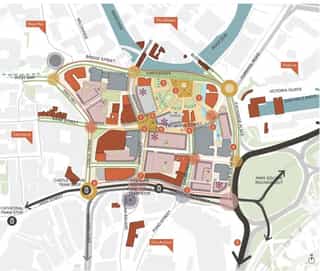
↑ Sheffield Neighbourhood Frameworks - A flexible framework for delivering city regeneration
Key Outcomes
£5m+ in secured funding: Over £3m from Homes England and £1.5m from Sheffield City Region to support Sheffield Housing Companies' Housing Programme
£654,098 from the Affordable Homes Programme (2021-26) to support the Stock Increase Programme projects at Baxter Court and Meersbrook Park Road
Recognition as a Levelling Up Transformational Project: Sheffield is now high on the Government's agenda and will receive the funding and support it needs to maximise existing investment
Significant indirect economic impacts through the construction of 20,000 new homes, public spaces, and supporting infrastructure
Conclusion
The project comprises three distinct workstreams: the Sheffield City Centre Strategic Vision, City Centre Strategic Neighbourhood Guidance and supporting Delivery Strategy, and an Investment Prospectus. This suite of documents acts as a basis upon which Sheffield City Council will begin to realise its ambitions for creating a Sheffield City Centre that is fit for the future, as well as providing the platform to deliver a significant number of new homes as part of the curation of new distinctive neighbourhoods in the City Centre.
We have provided an innovative strategic framework at the city-scale; a generator for comprehensive, sustainable growth, supported by a bold vision. The plan considers physical, environmental, economic and social considerations holistically, and exploits interdependent connections across sectors to deliver cross cutting impacts and policy synergy. It then lands these principles at the neighbourhood level, the most important unit of change within any city, providing a framework of principles for catalyst sites which have been incorporated into the emerging Local Plan.
The framework has informed the emerging Local Plan, setting key principles for future development across the City Centre, and providing a new evidence-based document to demonstrate the spatial capacity for residential development.
Fundamentally, we have created a framework that allows for the City Council to lead a proactive approach to shifting viability issues, which have been a constraint on the city’s growth, based on a bold placemaking vision.
The documents have helped position Sheffield as one of the early ‘Transformational Projects’ announced in the Levelling Up White Paper. This has increased the economic profile of the city and has been pivotal in attracting further public/private investment - culminating in £3m in funding from Homes England and £1.5m from Sheffield City Region.
This approach now forms the blueprint for Homes England investment going forward.
Leeds Innovation Arc
Context and Approach
Leeds Innovation Arc evidences how a place-based strategy can deliver positive outcomes for innovation and inclusive growth. The lessons learned from Sheffield's holistic approach to city-making informed our methodology in Leeds, where we focused on creating an innovation ecosystem that would drive economic transformation whilst ensuring benefits reach all communities.
The Innovation Arc sets a clear vision for partnership and investment in Leeds. It supports the council’s inclusive growth ambitions, delivering a measurable impact towards a healthier, greener and inclusive future for all. It creates a framework for an innovation ecosystem that fosters new ideas, enhances productivity and catalyses inward investment.
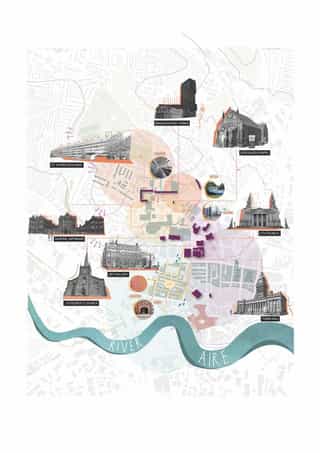
↑ Stitching together assets and neighbourhoods
The project started with spatial analysis and now forms a cornerstone of West Yorkshire's Investment Zone proposition, securing circa £30m government investment to date and setting the framework for future investment and growth.
Planit and Deloitte have been working collaboratively on a number of phases of work for the Leeds Innovation Arc (IA). The IA work does not comprise one single project, with the work undertaken to date forming part of an ongoing, evolving process, working towards the establishment of the Innovation Arc as a globally significant centre of innovation. This has included production of a spatial analysis of the area, then the Leeds Innovation Arc Supplementary Planning Document (SPD), which was adopted by Leeds City Council (LCC) in October 2023. Both documents informed the Leeds Investment Zone proposition, successfully securing funding in 2023, and helping to define development opportunities that will realise the Council’s ambition for the area over the next ten years.
We have been at the forefront of supporting LCC in realising the IA vision since 2021. Our expertise and insights have been instrumental in guiding the evolution of the IA from early spatial analysis and visioning to the development of an investment case that identifies a series of specific capital and revenue expenditure programmes, based on the city’s sectoral strengths.
We prepared spatial analysis of circa 125 hectare western area of the city centre, working alongside Civic Engineers. This analysis informed a refresh of LCC’s strategy for a post-Covid innovation district that focused on inclusive growth. Capitalising on our expertise and insights into UK and international best practice within the team, working with stakeholders we created a compelling vision, which has been critical in shaping the Innovation Arc proposition. Our breadth of experience also supported us in establishing a series of key performance indicators for success in a Leeds context and developed a clear delivery toolkit to support the analysis.
The Vision / Concept
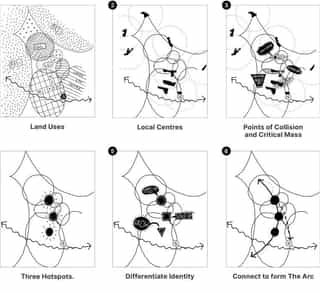
Our expertise in spatial analysis was instrumental in teasing out and identifying the spatial attributes that would support the potential for innovation to thrive in the area. The outcome of our collaboration was the development of the concept of an "Innovation Arc," a visionary and transformative initiative that stretches from the train station to the university campus, and is anchored by a series of hubs formed around the city's anchor institutions. This concept represents a significant milestone in the evolution of the city's innovation ecosystem.
The Arc
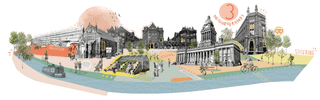
The Innovation Arc is where innovation uses in Leeds should be concentrated. The top of the Arc is formed by the university and in particular the long linear mass of the EC Stoner building. The tail of the Arc feathers out, reaching south west towards the River, whilst touching the edge of the station in the east. Within the Arc are three neighbourhoods which hold potential for innovation.
The Neighbourhoods
The SPD boundary comprises of 3 neighbourhoods. The neighbourhoods themselves do not form individual boundaries and are to be thought of holistically within the SPD area. Their strength lies in their overlaps and intersect and are well placed to draw in and reach out to better connect surrounding areas. Each neighbourhood naturally forms points of gravity, creating neighbourhood centres and hotspots for innovation.
The West End
The West End is made up of the area surrounding Park Square and Wellington Place. The neighbourhood is defined along its southern boundary by the River Aire and connects directly into City Square and Leeds Train Station to the southeast.
Great George Street
Great George Street Neighbourhood encompasses the LGI estate, Millennium Square to the east and Woodhouse Square to the west. The southern boundary of the neighbourhood is defined by Victoria Square, The Headrow and Westgate. Great George Street forms the key spine of the neighbourhood.
Woodhouse Gateway
The Woodhouse Gateway neighbourhood is focussed around the three campuses, Leeds Beckett University, University of Leeds and Leeds Arts University, with the brutalist architectural icon of EC Stoner at its heart. The neighbourhood extends north to include Hillary Place, the Brotherton Library and Leeds Arts University; south to meet with the LGI; west to incorporate Chancellor's Court and The Faversham; and east to include Blenheim Terrace and The Dry Dock.
Developing the SPD and Delivery
The Leeds IA was successfully launched at UK REiiF in 2022, generating significant interest from key stakeholders and underpinning the Council's wider collaboration with government and the financial and property sectors. The analysis underpinned the place-based vision set out by the Council at www.inclusivegrowthleeds.com .
Building on this analysis, we produced an SPD to guide planning decisions within the IA The SPD defines what innovation should look like in Leeds and outlines the vision and formulates principles to guide the future development in the area. Alongside its development management function, the SPD defines a clear shared purpose to give developers and investors confidence in the area.
The SPD defines what innovation means and will look like for Leeds and how it should translate spatially across the area. The guidance sets out appropriate types of development in the most suitable locations and are delivered in line with the vision and its objectives. The strategies - movement and connectivity, public open space, heritage and identity, people and culture and core and supporting uses - ensure the guiding principles of innovation meet those of placemaking collectively in any new development or public projects coming forward.
LCC adopted the SPD in October 2023, representing a key moment in the ongoing development of the Innovation Arc. This visionary document sets out the principles and guidance that will guide the area's continued growth, providing vital spatial definition for the IA and priority areas. The SPD creates a framework for collaboration, partnership, and investment. It establishes both the physical and non-physical context for collaboration, creating opportunities for anchor institutions, businesses, SMEs, entrepreneurs, the local community, and new talent to come together to drive innovation in critical areas such as healthtech, green finance, culture, and digital creativity.
Investment Case Development
During 2023 we continued to work collaboratively with LCC to develop an Investment Case and supporting evidence base for the Leeds IA. This comprehensive case captures a compelling mission statement for the Arc, the pillars on which this could be developed, and how this may feed though into compelling propositions and projects, by presenting a series of specific capital and revenue expenditure programmes.
Supporting inclusive growth is a key priority for LCC. By capturing stakeholders' successes to date and investment plans already in place, drawing these together in a collaborative spirit, we articulated a mission statement for what the Arc and the city will look like by 2030. Our strong and clear mission statement, alongside the established IA vision, acts as a golden thread throughout the Investment Case, seeking to establish Leeds as a global centre for innovation that drives and delivers measurable impact towards a healthier, greener, and inclusive future for Leeds and the world.
Within the Investment Case, we sought to establish through a robust evidence base the wealth of sectoral specialisms and local characteristics that underpin the uniquely Leeds proposition. This was supported by close collaboration with officers and the key stakeholders within the Arc, including a series of workshops with LCC's officers in economic development, regeneration, and innovation programmes, and representatives from Leeds NHS Trust, University of Leeds, Leeds Beckett University, and key business stakeholders.
Key Outcomes
- £30m in secured government investment through the West Yorkshire Combined Authority (WYCA) Investment Zone
- 2,500+ jobs projected over the next five years
- £200m+ investment expected across the West Yorkshire region
- Funding secured for: refurbishment of heritage assets, health innovation programmes, and collaborative masterplanning within the Arc
To date, Leeds Innovation Arc has secured £30M of government investment, following the governments recently announced West Yorkshire Combined Authority (WYCA) Investment Zone. Our work was fundamental in defining the Leeds proposition that fed into WYCA’s successful Investment Zone ask to Government. Our work also forms the basis of a further ask to Government for round two investment zone funding.
The Government’s announcement in Autumn 2023, is expected to generate over 2,500 jobs and over £200 million investment across the West Yorkshire region over the next five years. Whilst the Investment Zone is geographically located within the local authority districts of Bradford, Kirklees and Leeds, the Leeds Innovation Arc represents a significant anchor hub.
Our continued work and involvement in shaping the Leeds Innovation Arc has played a key role in securing the Investment Zone for West Yorkshire, as well as the associated funding for the Innovation Arc. This represents a significant milestone in establishing Leeds as a globally significant centre of innovation. The Government’s IZ programme is aimed at catalysing a small number of high-potential clusters in areas in need of levelling up to boost productivity and growth, which supported by the wider Leeds Innovation Arc offer will help generate inclusive growth, that delivers economic, social and environmental outcomes.
Our role in delivering a clear overarching vision and framework for the IA helps to support future investment and funding in innovation that responds to some of the biggest challenges facing the UK today, such as supporting the transition to a green economy and the cost of living crisis, and delivering more inclusive, positive health and wellbeing outcomes by reducing health pressures and improving accessibility to health diagnostics.
In developing the Innovation Arc vision and proposition, we recognised the need to create the right conditions and environment for the innovation ecosystem to thrive and, in turn, generate inclusive growth, including economic outcomes. As such, our spatial-led work has focused on identifying areas of the city where existing neighbourhoods and pockets of activity overlap, and within these locations, hubs of innovation should occur. Our output and ongoing involvement in the project recognises that for innovation to occur and economic activity to be enhanced, there needs to be a balance between more exclusive space for such activities as well as inclusive public-facing integration with the city.
To ensure that the ingredients of innovation were holistically set out to test the emerging projects, we developed a comprehensive approach that considered movement and connectivity, public open space, people and culture, core supporting uses, and heritage and identity. By doing so, we created a framework that allowed for innovation to flourish and economic growth to be inclusive, sustainable, and impactful.
The spatial framework and defined investment proposition have collectively sought to create the optimal conditions for innovation to thrive through consideration of both the built environment and activities taking place within these spaces. Our work has and will continue to help unlock investment and growth within the innovation, which is already evidenced by the Government’s WYCA Investment Zone, which is set to act as a catalyst for future funding and investment from both the public and private sectors.
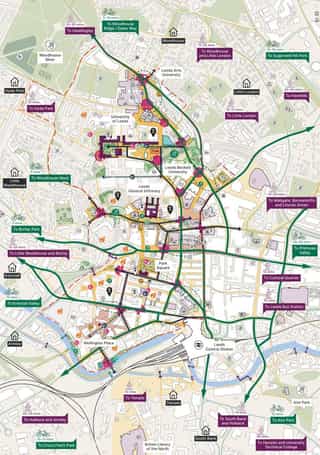
↑ A City Wide Strategy for Innovation
Conclusion
Over the last three years Deloitte and Planit played a crucial role in translation the vision into a tangible concept through the production of the Leeds Innovation Arc SPD . It provides a unique way of spatialising innovation and economic activity in a way that allows synergies between the physical environment, people, new ideas and investment to agglomerate.
The SPD, defines the project’s vision and guiding principles for future funding decisions and development proposals. To address the challenges of disconnection between the institutions located in the Arc and the surrounding communities we undertook spatial analysis to determine key priorities to maximise the Innovation Arc’s potential. This included establishing a clear set of development principles, which supported by a clear overarching vision will act as a catalyst for future investment and regeneration, that supports the strategic growth ambitions of the Innovation Arc and wider city. The Leeds Innovation Arc also supports the Government’s vision, as set out in the UK Innovation Strategy, to make the UK a global hub for innovation by 2035.
The project adopts an innovative approach in creating opportunities to better link education and health institutions co-located in the city centre, with exisiting businesses, SME’s and entrepreneurs to create a place that supports and nurtures new innovative ideas, through the establishment of an innovation ecosystem. The Innovation Arc project represents a unique proposition for Leeds to become national and globally recognised leader in innovation.
We have successfully supported our client through multiple stages of the Innovation Arc process and continue to play a significant role in bringing it the forefront of the City and stakeholder’s consciousness as a concept that can help to secure Leeds next stage of inclusive growth and meet its strategic “Best City” objectives. This collaboration between Deloitte, Planit, Leeds City Council and other stakeholders has ensured a holistic and place-based approach, that successfully recognisees and buildings upon the city’s existing strengths.
Our ongoing involvement in the Innovation Arc project since 2021, also demonstrates our innovative multi-disciplinary approach to support LCC in their journey from concept through to investment and delivery.
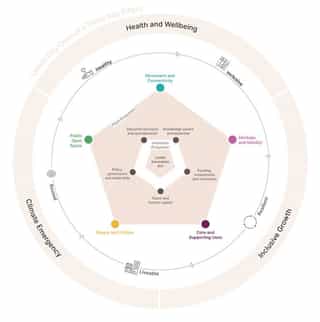
↑ Innovation Ecosystem
Hull City Centre
Context and Approach
Our experience in developing the Leeds Innovation Arc for Leeds City Council and the Central Area Strategy for Sheffield City Council has informed our approach in developing the City Centre Vision for Hull, whereby solutions are derived from the unique characteristics of a place as well as the generics of typology and capacity. The three-city approach demonstrates how our methodology adapts to each location's distinct challenges whilst maintaining the core principles of place-based transformation.
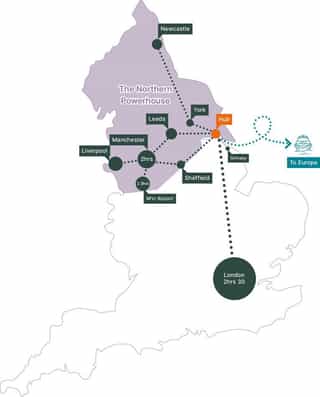
↑ Connectivity
Driving Transformation
Since its maritime heyday, Hull has faced a wide range of significant challenges, including a loss of population density, a decline in retail, anti-social behaviour, congestion, and childhood obesity. It also suffers from a lack of green spaces, an abundance of car parking across the city centre, and is at significant risk of flooding. Acknowledging and understanding these challenges is the starting point.
Hull City Council has now unveiled a bold 20-year vision for the long term regeneration of its city centre and surrounding neighbourhoods. Its transformation will be shaped by a suite of strategic documents – a council plan, community and cultural strategies, alongside the City Centre Vision. Their successful delivery will leverage the city’s existing unique assets – its East Yorkshire and North Sea location, strong community spirit, independent and creative talent, welcoming nature and maritime heritage. Together with a strong collective desire to build a city for the future – one that is prosperous, resilient, connected and inclusive.
The Vision
The Vision supports the Housing Growth Plan, adopted in January 2025,which aims to build nearly 6,000 new homes by 2031 (target - 993 homes/year from 2025-31) in Hull to meet government / council targets.
In 2024, place designers Planit were commissioned by Hull City Council to lead a team* who could develop a City Centre Vision that reimagined it by 2045. Over the course of the project our team have developed a deep affection for the city, it’s unique maritime character and the huge potential the city centre holds. The wide-reaching spatial plan aims to deliver a diversified city centre that will bring forward new and enhanced residential developments and neighbourhoods, public realm improvements, catalyst projects which will drive transformation, unlock investment and provide opportunities for local people. It will cement the city’s maritime cultural and visitor identity.
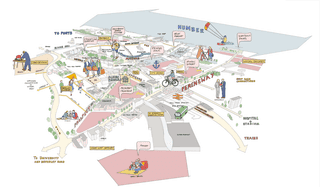
↑ © Shed KMVision for Hull - Yorkshire's maritime city and the UK's green energy capital....a creative place to live, work, play
Shaped by Engagement
Key stakeholders and the public have been an essential element of informing the future of Hull’s city centre. Counter Context and Planit have designed and delivered a robust engagement programme incorporating two stakeholder engagement periods including ward members and MPs, businesses, key service providers and cultural, heritage and accessibility organisations. In addition, two public engagement events have taken place which have highlighted the desire for improvements around accessibility and transport, a need for more public spaces, an early-evening economy and more city centre living. The early conversations with local people helped the team identify harder to reach groups across the city centre which then informed the later stages of engagement.
Hull people know Hull best and their passion and enthusiasm for the city has informed the positive, bold and ambitious narrative underpinning the 20 year vision.
Strategic Drivers
The Vision is underpinned by a handful of key strategic drivers: including innovation, resilience to climate change, health, productivity and liveability which re-establishes a residential population and strong workforce within the city centre. It will deliver healthy and playful green spaces for all, build a liveable and active city centre with vibrant neighbourhoods and fosters culture and creativity.
Twelve opportunity areas and catalyst projects across the city with the potential to deliver transformational and lasting change have been identified. Those that are already in the development pipeline include Albion Square, East Bank, and Paragon. Others include Myton Street, Hull’s college site and an emerging Innovation Corridor along Ferensway.
The spatial interventions are importantly supported by a delivery strategy. Deloitte have carefully crafted a strategy which advises on the long-term approach to governance, funding, partnership working, addressing issues of viability, and phasing to ensure the Vision is an enabler and driver for change.
Beyond the City Core
The Vision team, in collaboration with Hull City Council and stakeholders, established that areas beyond the city centre hold huge potential for the future success of the city centre. They provide residential development opportunities, important strategic connections to surrounding communities, key destinations and employers, and include major green and blue infrastructure corridors – all vital ingredients in the long-term sustainability and liveability of the city centre.
Implementation and Next Steps
Local Plan Integration
The Vision is not itself a planning document with statutory weight (like the Local Plan), but is intended as a strategic guide/overlay that helps shape future policies, priorities, allocations and regeneration strategy.
Going forward, design solutions produced for individual sites will form part of the updated Local Plan, including candidate allocations, that will guide future development.
Some elements of the Vision (design quality, public realm, detailed masterplans) may be turned into design guidance, design codes, or supplementary planning documents (SPDs) that sit alongside or support the Local Plan.
The Local Plan, once adopted, will include monitoring and periodic review, which can bring in Vision priorities as constraints or triggers for policy updates
In summary: the Vision will inform what policies and allocations are developed, where they are focused (especially in the city centre), and how development should be designed and phased.
Completion of the current projects
The vision helps to build momentum around the current development pipeline, which includes:
- East Bank Urban Village, a mixed-use development including up to 850 new homes, green space, streets and plazas. Hull City Council has selected ECF (Muse / Legal & General / Homes England) as development partner, Funded via Levelling Up.
- Albion Square, transform a derelict city centre site into homes, shops, offices and urban park. Also includes a Community Diagnostic Centre for imaging (NHS: X-ray, CT, MRI) integrated.
- Myton Street, provides a dense new development cluster surrounding the Arena, and opening up onto Princes Quay, for new workspace, hotel and residential uses.
- Other supporting infrastructure projects such as: Hull Maritime project and Public realm / connectivity upgrades around High Street / Princes Dock Street / Humber Dock Street
Mayoral Context
Luke Campbell being elected as the new Mayor of Hull & East Yorkshire (for Reform UK). Powers include housing and planning (mayoral development areas, possibly a mayoral development corporation), transport strategy, economic development, business support, skills, regeneration.
The Mayor has a budget for about £13.3 million per year in core investment funding under the devolution deal, plus additional pots: for transport, flood/coastal erosion, economic growth, brownfield housing site development amongst other areas.
While Reform UK at a national level has criticised net zero policies, and even said it would impose taxes on renewables, Campbell has expressed support for green energy projects where they bring jobs.
The Vision provides a clear framework along with pipeline projects to help deliver HEYCA's key regeneration goals.
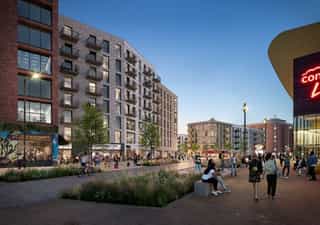
↑ © Virtual Planit - Catalyst Project (Myton Street Regeneration area) in development pipeline
Conclusion
The Hull City Centre Vision demonstrates how Planit's established city thinking methodology can be adapted to address the unique challenges and opportunities of each place. Building on lessons learned from Sheffield and Leeds, the Hull project has created a bold 20-year framework that addresses the city's specific challenges - including flooding risk, population decline, and limited green infrastructure - while capitalising on its distinctive maritime heritage and strong community spirit.
Through comprehensive stakeholder and public engagement, the Vision has established a clear pathway for transformation, identifying twelve opportunity areas and catalyst projects that will drive regeneration. With the support of the newly elected Mayor and the Hull & East Yorkshire Combined Authority's devolution deal funding, the Vision provides a strategic framework to guide both the emerging Local Plan and key pipeline projects, including East Bank Urban Village and Albion Square.
This approach positions Hull to deliver nearly 6,000 new homes by 2031 whilst creating a more liveable, resilient, and prosperous city centre that serves all residents. The Hull project exemplifies how place-based visioning, when grounded in local assets and community aspirations, can unlock transformational change even in cities facing significant regeneration challenges. It demonstrates that our methodology - proven in Sheffield and refined in Leeds -can be successfully applied to diverse urban contexts, always maintaining the principle that the neighbourhood is the most important unit of change within any city.
Article Takeaways
Planit's work across Sheffield, Leeds, and Hull demonstrates that successful urban transformation requires more than generic planning approaches - it demands bespoke, place-based strategies that recognise each city's unique strengths, challenges, and aspirations. Through our city thinking methodology, we have established a proven formula that creates compelling visions, identifies strategic catalyst sites, and galvanises delivery partners to achieve transformational change.
The results speak for themselves:
- Sheffield has secured recognition as a Levelling Up Transformational Project with over £5 million in funding, created a framework for 20,000 new homes, and set an ambitious path to net zero by 2030
- Leeds Innovation Arc has unlocked £30 million in Investment Zone funding, positioned the city as a globally significant innovation hub, and created a framework expected to generate over 2,500 jobs and £200 million in investment
- Hull has developed a 20-year vision that addresses decades of decline whilst leveraging its maritime heritage to create a framework for nearly 6,000 new homes and comprehensive regeneration
What unites these projects is our commitment to holistic city-making that considers physical, environmental, economic, and social considerations simultaneously. By landing strategic principles at the neighbourhood level - the most important unit of change within any city - we create frameworks that are both visionary and deliverable. Our collaborative approach, working alongside partners like Deloitte and engaging extensively with communities and stakeholders, ensures that visions are rooted in local ambitions whilst attracting national and international investment.
Each project has informed the next, building a body of expertise that demonstrates adaptability and innovation. Sheffield's focus on the "Outdoor City" showed how a clear, distinctive narrative can galvanise transformation. Leeds refined this approach by creating an innovation ecosystem that spatialises economic activity in new ways. Hull has built on both precedents to address complex challenges including flood risk and population decline, demonstrating the robustness of our methodology across diverse urban contexts.
As cities across the UK face mounting pressures - from climate change and housing shortages to economic transformation and social inequality - Planit's city thinking approach offers a proven pathway to creating places that are not just functional, but truly transformational. We continue to support Local Authorities, Developers, Homes England, and collaborators in creating compelling, investable place-based narratives that deliver lasting change for communities, economies, and the environment.
Related Thoughts

Power of Networks
Power of Networks

Regenerative Urbanism - Principle 1: Designing for co-evolution
Regenerative Urbanism - Principle 1: Designing for co-evolution

CyanLines – building an ecosystem movement.