Water is a defining challenge in shaping successful places today. From dense city centres to new neighbourhoods, landscapes must now respond to heavier rainfall, increased flood risk and the need for long‑term climate resilience. In response, many of our projects are re-thinking how water is managed within the public real, how integrated approaches to surface water management, rain gardens, swales and floodable landscapes, can deliver functional flood mitigation while improving the quality, character and ecological value of public spaces.
Central Dock, Liverpool Waters
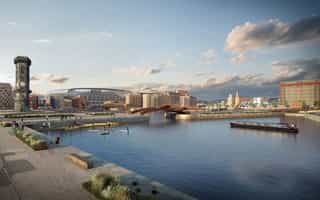
Climate change is increasing flood risk across the city region. As part of the large-scale regeneration of Liverpool Waters, a new 5‑acre park is being delivered within the historic docks. Water will share both function and character. This nature‑led landscape has the ability to capture, flow, filter and store surface water. Wetland depressions and swales collecting water from adjacent streets and spaces will feed directly into the park and be collected within wetland basins in this nature area. It will provide a wilder type of landscape in an urban environment and have the ability to capture, flow, filter and store surface water runoff through a variety of features and processes. Features include: On-street rain gardens, A gentle flowing water play area on the lower side of retaining features, wetland retention basins and associated planting.
Meadow Lane, Leeds
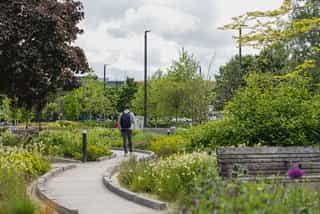
Nestled between the River Aire and emerging Aire Park lies a pocket park space that links Leeds’s South Bank to the city centre. Meadow Lane provides a vital green and blue biodiverse link in place of a dual carriageway and car parking offering up a strong verdant space. This allows for sustainable drainage using level changes to allow rainwater to fall into attenuation features. Further, a mixture of visible water capture points (slots or channel drains) ensures water fall will be captured within the site and a permeable landscape surface will allow water to permeate through this is then captured and moved into the rain gardens for attenuation, areas of soft landscaping will be positively drained and will slow water flow rate.
Altrincham Town Centre
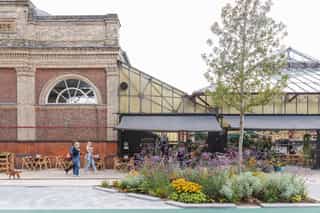
The old market town of Altrincham has flooded several times over recent decades causing inconvenience and damage to housing and commercial properties. A series of flood mitigation measures have been implemented to control the rising impact of climate change.
Sustainable drainage systems (SuDS) scheme has been developed across three streets. This has involved planting rain gardens, low-maintenance wildlife friendly spaces, which work to capture and store water. Specific plants good at retaining high levels of rainwater over a short period have been used which reduce pressure on our water systems during periods of high rainfall. Porous asphalt was used for new paving and cycle lanes to capture rainwater at the surface and retain it for longer. A new eco-friendly rain garden has further been added higher above the town improvements to provide a sustainable way to improve drainage and capture rain and surface water.
Oldham Town Centre, Greater Manchester
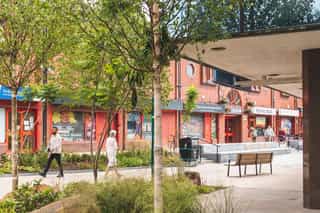
Oldham Town Centre is being reimagined as a place where nature, people and urban life work together. Central to this transformation is a regenerative design approach that goes beyond mitigation, actively restoring and enhancing ecological function so the landscape can adapt and perform over time. A network of interconnected rain gardens forms the backbone of this approach, creating a visible, living drainage system transforming the town centre.
Manydown, New Garden Community, Basingstoke
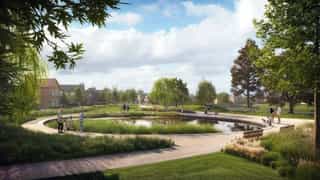
A new neighbourhood with thousands of new homes, schools and work hubs will deliver a healthy, connected and climate adaptive place, a stones throw from Basingstoke town centre. The new 2ha+ green park will act as a floodable landscape, providing infiltration for surface water drainage from the surrounding development. Moisture tolerant species will stabilise banks and create wetland-edge habitat.
CityLabs, Manchester City Centre
At Citylabs in Manchester city centre, water management is embedded into the public realm rather than engineered out of sight. Rain gardens and a linear swale are integrated along the Boulevard to intercept, slow and manage surface water at source, providing attenuation before release to the drainage network. Designed as both infrastructure and landscape, the swale uses segmented channels and resilient planting to manage flows during heavy rainfall while supporting biodiversity.
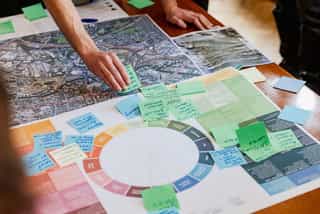
Designing for all Life to Thrive in Balance
Our regenerative practice research has led to the development of a design tool informed by Doughnut Economics. We recently launched this tool to the public and it supports decision‑making at key stages
of the design process, connecting designers to best‑practice guidance and helping balance social, environmental and technical priorities at both local and global scales.
The tool shapes our approach to water and flood risk from the outset. By understanding catchment context, flood pathways, exceedance routes and future climate scenarios, it helps identify opportunities to slow, store and manage water at source. SuDS, blue‑green infrastructure and floodable landscapes all reduce pressure on drainage networks while delivering long‑term climate resilience.
Related Thoughts

Our Environmental Management System
Our Environmental Management System
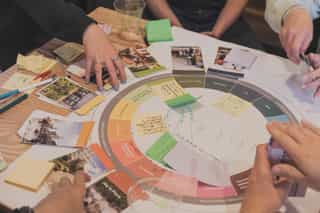
Planit’s Regenerative Design Tool Launches
Planit’s Regenerative Design Tool Launches
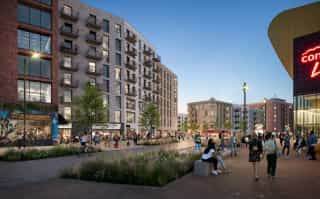
Hull City Centre Vision: Creating a Connected, Liveable and Climate-ready City by 2045