Systems Thinking: No Urban Panacea But A Roadmap to Enlightenment
InsightsCities, regions, and neighbourhoods operate as inherently complex systems. Understanding how these systems work is crucial for designers.
They comprise interconnected elements that produce behavioural patterns over time. The key challenge lies in understanding the relationship between structure and behaviour - how elements interact, what causes negative impacts, and how to foster better patterns through leverage points in the system.
Systems operate simultaneously in multiple directions; are more than the sum of their parts - adaptive, dynamic, self-preserving, and often evolutionary, making them resilient to impacts. Elements can be physical (neighbourhoods) and non-physical (civic pride), with many interconnections flowing through information exchange.
Stocks represent the system's foundational carrying capacity-elements you can measure or count that buffer against shocks. Gain insight by studying these stocks over time through graphs and flow diagrams to identify inputs and outputs.
Feedback loops are crucial system components - causal connections from a stock through various decisions and actions. Information delivered through feedback loops affects future behaviour, creating both challenges and opportunities - e.g. where multiple factors influence community well-being.
Designers must grasp the interplay between flows, stocks, and feedback loops. A new development will only integrate into a neighbourhood when new relationships are formed with its social system - design for this!
With complexity comes hierarchy-subsystems like neighbourhoods can self-regulate; the larger city system coordinates and enhances neighbourhood functions.
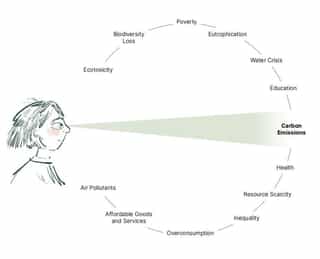
Shift from Siloed Thinking...
...to Whole Systems Thinking.
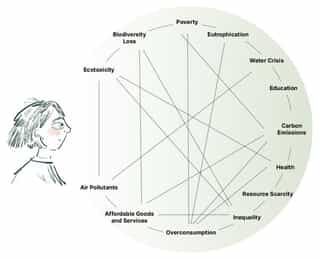
'Carbon Tunnel Vision' Adapted from Jan Konietz
OPERATING PRINCIPLES:
- Recognise model limitations: Our understanding will always be incomplete, making system changes inherently challenging.
- Observe how the system behaves before intervening.
- Value quality over quantity: Don't solely focus on measurable metrics - consider intangible factors.
- Implement adaptive policies that respond to system changes - leveraging AI for effective feedback integration.
- Embrace complexity: urban systems are messy, nonlinear, and unpredictable. Encourage controlled disorder, self-organisation and diversity.
- Consider multiple timescales: Effects can manifest immediately or much later. Systems couple and uncouple constantly across different scales.
- Think holistically: Cross disciplinary boundaries to understand the complete picture.
- Remember interconnectedness: All parts of the system affect each other - letting any part deteriorate will eventually impact the whole.
The path forward requires humility, continuous learning, and balancing intuition with rationality. We must embrace errors as learning opportunities while working toward the general good of the system.
Systems thinking can help create more resilient, adaptable, and liveable urban environments that serve all life while preparing for future challenges.
Related Thoughts

Regenerative Urbanism - Principle 1: Designing for co-evolution
Regenerative Urbanism - Principle 1: Designing for co-evolution

Regenerative Urbanism - Principle 2: Partner with Place
Regenerative Urbanism - Principle 2: Partner with Place

Regenerative Urbanism - Principle 3: Call forth a collective vocation